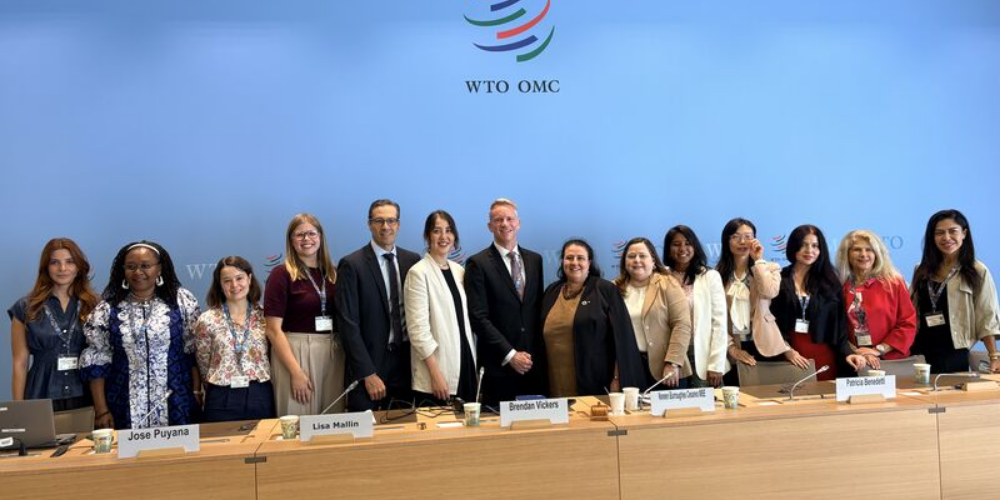
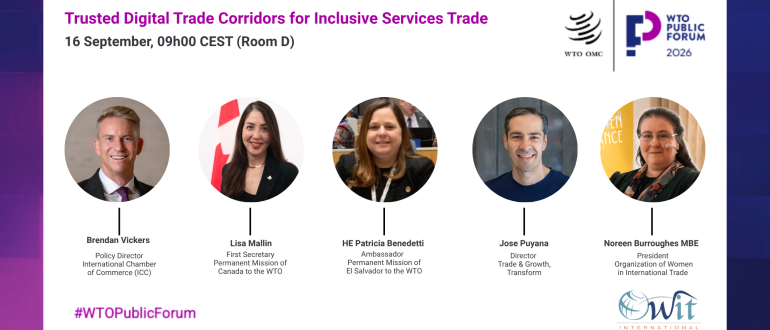

OWIT International convened a featured session at the **WTO Public Forum 2026 in Geneva on 16 September**, bringing together senior international trade leaders and practitioners to explore how **Trusted Inclusive Digital Trade Corridors** could help more businesses participate successfully in global trade.
The session, Trusted Inclusive Digital Trade Corridors for Inclusive Services Trade, will move beyond discussion of digitalisation itself to examine a practical question: **how can existing trade systems, services and ecosystems be better connected to create a more seamless, trusted and inclusive international trade journey?**
International trade already depends on a complex ecosystem of government systems, digital platforms, finance and payments, logistics, customs, professional services, business networks and trade support organisations. Yet these often remain fragmented from the perspective of the businesses trying to navigate them. For smaller and underserved businesses—including women-owned SMEs—those gaps can create additional barriers to entering and growing in international markets.
Moderated by Noreen Burroughes Cesareo MBE, President of OWIT International, the discussion brought together four complementary perspectives:
H.E. Patricia Benedetti, Ambassador and Permanent Representative of El Salvador to the WTO and Co-Chair of the WTO Informal Working Group on Trade and Gender, will bring the trade and gender perspective, considering what needs to be designed into future digital trade systems if they are genuinely to widen participation for women-owned businesses and other underserved traders.
Brendan Vickers, Policy Director at ICC United Kingdom, mapped the wider trade ecosystem and explored what needs to connect—from platforms and enabling services to trusted data, digital identity, standards and interoperability.
H.E. Michelle Cooper, Ambassador and Permanent Representative of Canada to the WTO, drew on Canada’s experience across digital trade, cross-border data, electronic transactions, SME participation and inclusive trade to consider what existing practice can teach us about the building blocks required.
Jose Puyana, Director of Trade and Growth at Transform, turned the conversation towards implementation: how these principles can translate into practical, user-centred systems that work across different markets and levels of digital maturity.
Bringing the wider trade ecosystem into the room, importantly, this was not a traditional “talking heads” panel. A group of invited respondents joined the conversation from the room, bringing additional perspectives from government, international organisations, regional trade ecosystems, academia, investment and entrepreneurship.
These include perspectives from the Enhanced Integrated Framework (EIF), the UK Department for Business and Trade, academia and SME research, entrepreneurship and investment networks, as well as entrepreneurs themselves. The wider session framework also brings in experience and perspectives from organisations and initiatives and OWIT colleagues from our global network.
Their role helped pressure-test the proposition against experience on the ground: what would interoperability and inclusion mean across markets with very different levels of digital readiness? What can existing initiatives teach us? Where do SMEs and women entrepreneurs encounter the greatest barriers? And what could governments, international organisations, business networks, researchers, investors and entrepreneurs contribute to taking the concept forward?
The discussion therefore moved from mapping the trade ecosystem and understanding what needs to connect, through existing practice and inclusion by design, to the practical questions of interoperability, governance, trust and implementation.
The ambition is not to leave Geneva with a finished model. It is to identify the principles, building blocks, existing initiatives and potential partnerships that could enable the concept to progress towards practical prototype and pilot development.
For OWIT International, this conversation goes directly to our mission. As international trade becomes increasingly digital, the challenge is to ensure that the systems being developed do not simply make trade easier for those already participating, but create practical pathways for more women entrepreneurs, SMEs and underserved businesses to access and grow in international markets.
We thank you to all our welcoming members of the OWIT global network and the wider international trade community to the discussion and your participation.
I recommend that you learn from others in a competent, international association which helps develop your vision and gain the skills you need to achieve your goal. At OWIT International, I have learnt practical thought leadership. Join OWIT events on: www.owit.org for insights and strategies on networking.
Author: Noreen Burroughes Cesareo MBE FRSA,and the President, Organization of Women in International Trade (OWIT) and the Founder & Principal, Market Accents, specialises in strategic marketing, research, branding, PR and communications.