
Connecting trade policy with the realities of doing business across borders.
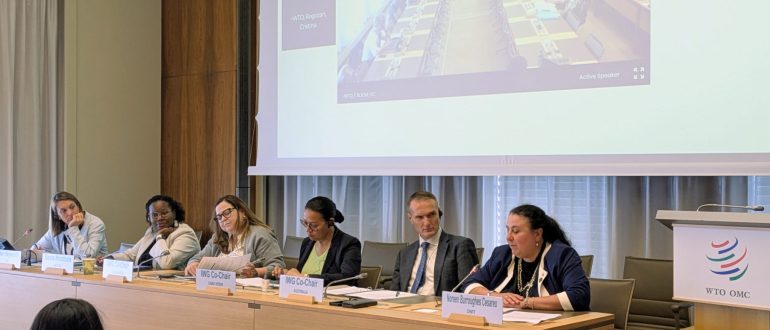
It was a privilege to represent the Organization of Women in International Trade (OWIT International), as its President, at the September meeting of the WTO Informal Working Group on Trade and Gender in Geneva.
Coming just days after the WTO Public Forum, where I convened and moderated our session on Trusted Digital Trade Corridors for Inclusive Services Trade, the meeting provided another important opportunity to connect international trade policy discussions with practical experience on the ground.
It was also an opportunity to share the achievements of OWIT’s global network, particularly how our chapters are helping women entrepreneurs and trade professionals develop the knowledge, skills, connections and confidence to participate more fully in international trade.
Drawing on my own experience in international trade, market development and working with businesses seeking to enter and grow in new markets, I wanted to reinforce a point I consider fundamental: access to international markets is not simply about opening doors. It is also about strengthening the ecosystem and enabling businesses to navigate what lies beyond them.
Trade agreements and policy commitments can create opportunities, but smaller businesses still face the practical complexities of market entry — understanding regulatory requirements, identifying credible partners, accessing finance, navigating distribution and payment systems, and developing the capabilities to compete internationally.
These challenges can be particularly acute for women entrepreneurs, especially those operating smaller businesses with limited resources and international networks.
This is why the work of organisations such as OWIT matters.
During my intervention, I shared examples of how our chapters and partners are helping address these challenges:
🔹 Training and trade capacity building — through workshops, webinars and practical programmes covering export readiness, market access, international business development and the skills needed to operate across borders.
🔹 Mentoring and leadership development — including OWIT Lake Geneva’s Rise & Lead initiative and OWIT Toronto’s work supporting emerging women leaders, demonstrating the lasting impact of mentoring, encouragement and professional networks.
🔹 Supporting internationalisation — including OWIT UK’s Going Global initiatives with NatWest, helping businesses strengthen their understanding of international opportunities and the practicalities of expanding into new markets.
🔹 Regional trade engagement — through our expanding African chapter network and involvement in initiatives supporting women’s participation in trade, including opportunities arising from the AfCFTA.
🔹 Cross-border commercial connections — drawing on our international network to connect entrepreneurs, professionals and businesses, helping relationships develop into meaningful commercial partnerships.
What I find particularly valuable is that these activities are interconnected. Training builds capability, mentoring builds confidence, networks create connections, and partnerships help turn those connections into opportunities. Together, they contribute to more sustainable participation in international trade.
I also highlighted the challenges of sustaining and scaling this work. OWIT is largely volunteer-driven, and the commitment of our chapter leaders and members is exceptional. However, extending our reach and impact requires resources, institutional partnerships and greater collaboration across the trade ecosystem.
For me, one of the continuing challenges in international trade is the gap between policy ambition and practical implementation.
We already have considerable expertise, infrastructure, institutions and support mechanisms across the international trade ecosystem. Yet these are not always sufficiently connected, accessible or easy for smaller businesses to navigate.
This was also central to our discussion at the WTO Public Forum: how can we better connect existing systems, services and institutions rather than duplicate them, and build solutions around the needs of the businesses they are intended to serve?
I believe this is where we need to focus greater attention — strengthening the links between policy, institutions and practical business support, while ensuring that the experiences of entrepreneurs and trade practitioners inform how solutions are designed and delivered.
OWIT has an important role to play, bringing the perspectives of its members into international discussions while supporting practical action through its chapters and partnerships.
My thanks to the Co-Chairs of the WTO Informal Working Group on Trade and Gender for the opportunity to contribute, and to our OWIT leaders, chapters and members around the world whose achievements I was proud to share.
Ultimately, the success of inclusive trade policy should be measured not only by the commitments we make, but by the businesses and people who are better equipped to participate, compete and succeed in international markets.
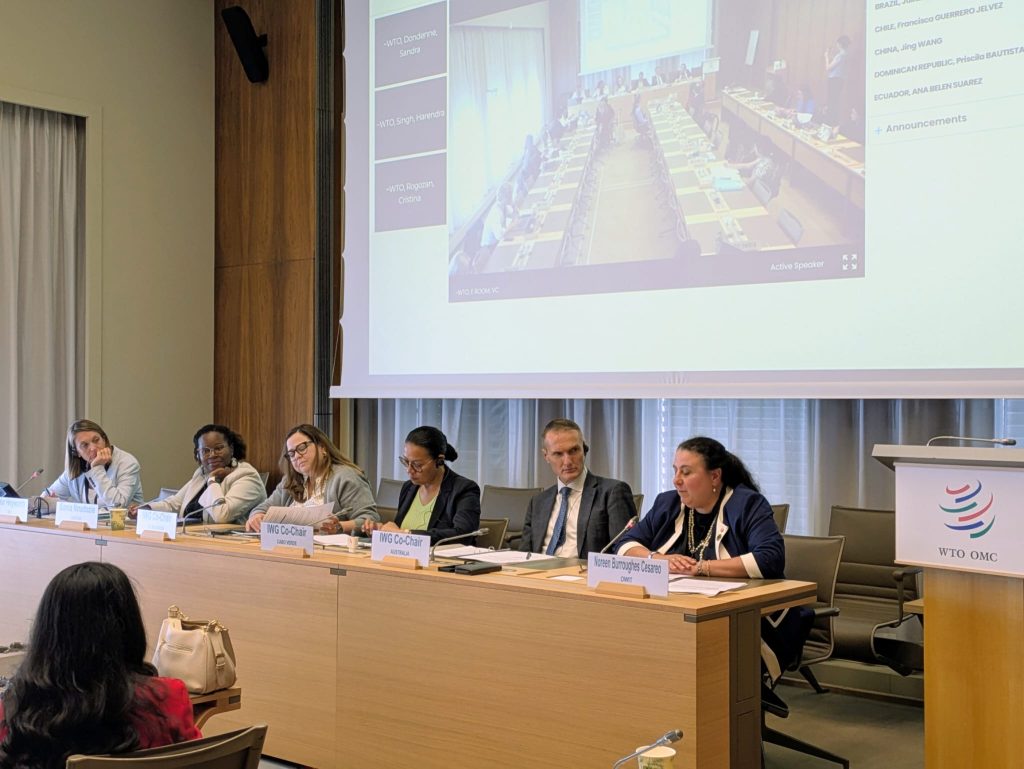
Presenting OWIT International at the WTO IWG meeting in September 2026